Ski eyewear has to manage several competing demands at once: the frame needs to sit securely, the lens needs to provide a broad visual area, and the interface around the face should remain comfortable through changing conditions. For brands developing OEM Ski goggles, the choice of foam and its density deserves as much attention as lens technology because the material directly influences how the frame interacts with the skier.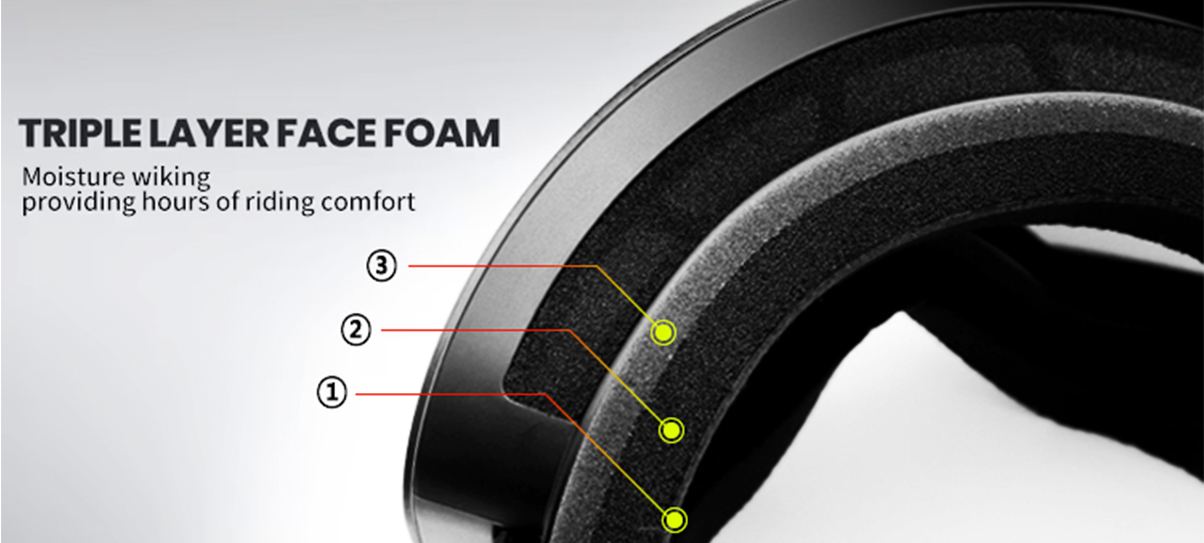
A ski goggle does more than cover the eyes. Its facial interface helps create a stable fit while limiting unnecessary exposure to cold air, snow, and wind. Foam that is too firm may create pressure points, whereas material that compresses too easily can alter the fit during prolonged wear. A carefully considered density structure therefore supports both comfort and consistent positioning.
Breathability introduces another design consideration. Heat and moisture generated around the face can accumulate inside the goggle, particularly during active skiing or snowboarding. A breathable sponge structure gives humid air a better path away from the face while maintaining enough cushioning for everyday use. The objective is not simply to add more foam, but to balance compression, airflow, and facial contact.
For YIJIA Optical, these considerations are part of the broader process of developing sports eyewear around practical use rather than treating the frame as an isolated component. Our OEM and ODM work covers different sports-goggle requirements, allowing material choices to be considered alongside lens construction and overall frame design.
Multiple foam layers can distribute contact more evenly than a single material layer. Instead of concentrating pressure in one narrow area, the structure can create a more gradual transition between the rigid or flexible frame and the skier's face. That difference becomes noticeable during long sessions, particularly when the goggle is worn continuously with a helmet.
The density of each layer also has a role in how the goggle responds to movement. A softer surface layer can improve the immediate feel against the skin, while supporting layers can contribute to shape retention. Such an arrangement gives designers more flexibility than simply increasing the thickness of one piece of foam. In practical terms, the layers can be viewed as a contact layer for skin comfort, a cushioning layer for pressure distribution, and a supporting layer that helps maintain the interface structure.
For brands developing custom logo Ski goggles, foam construction should therefore be considered as part of the early product-development process. Logo placement may receive most of the visual attention, yet the underlying comfort system influences how users experience the finished product.
A useful way to evaluate the structure is to consider comfort and airflow together rather than treating them as separate specifications.
Breathability does not mean leaving the facial area completely open. A ski goggle still needs a controlled interface that helps reduce direct exposure to cold wind and snow. The challenge lies in allowing accumulated heat and moisture to move through the structure without creating excessive gaps around the face.
This balance becomes particularly relevant for active users who move between climbing, skiing, and periods of rest. During higher exertion, moisture generation can rise quickly; during slower periods, the surrounding temperature may become more noticeable. A thoughtfully designed sponge system needs to accommodate these changes without relying on a single material property.
In our work at YIJIA Optical, we look at the relationship between frame construction, lens performance, and facial-contact materials as part of the same product-development discussion. That approach is useful for businesses that need sports eyewear to serve a defined market rather than simply reproduce a generic frame.
The key lesson is simple: cushioning should contribute to ventilation and fit at the same time, because optimizing one characteristic in isolation can create compromises elsewhere.
Comfort is influenced by more than the softness of the foam. The relationship between facial shape, frame dimensions, lens structure, helmet compatibility, and strap tension can all affect how pressure is distributed. A material that feels comfortable in isolation may behave differently once the complete goggle assembly is worn.
Product developers should therefore assess the entire wearing system during sampling. Checking facial contact, ventilation, lens stability, and compatibility with other equipment can reveal issues that specifications alone cannot show. User testing is especially valuable because different face shapes and skiing habits produce different requirements.
For businesses sourcing OEM Ski goggles, this evaluation process can also help distinguish meaningful material improvements from cosmetic changes. The right questions concern pressure distribution, moisture management, optical positioning, and how the goggle performs after extended use rather than simply how the product looks in a product photograph.
The most effective development decisions usually come from examining several interacting factors instead of assigning all performance expectations to one component.
A ski goggle's facial interface may not attract as much attention as its lens, but its influence on everyday wear is substantial. A multi-layer sponge structure can help balance cushioning, support, and airflow, while the lens and frame determine how those benefits function within the complete design. For brands considering custom logo Ski goggles, understanding these relationships makes it easier to evaluate whether a proposed product genuinely matches its intended market.
Our team at YIJIA Optical approaches sports eyewear development with these connected requirements in mind. The YH693 features a frameless magnetic ski-goggle design, while its listed lens functions include anti-fog, polarized, and UV400 protection. These details show why a ski-goggle project should be assessed as a complete system, where comfort materials, optical construction, and customization choices support one another. Such details show why a ski-goggle project should be assessed as a complete system, where comfort materials, optical construction, and customization choices support one another.

